
THORACIC SURGERY &
INTERVENTIONAL PULMONOLOGY
Laser Solutions
for Thoracic Surgery
Minimally invasive laser surgery for lung metastases and bronchial tumors
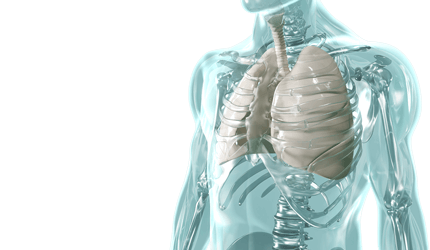
For many thoracic surgeons, the application of medical laser technology is the first choice in their operating room. The procedure enables a safe, tissue-conserving treatment of sensitive lung tissue while preserving hemostasis. For interventional pulmonology, the laser allows precise, gentle, and fast procedures for bronchoscopic tumor ablation.


Benefits of the technology
Minimally invasive laser procedures are a gentle, fast, and efficient option for lung and bronchial system surgery.
From a large number of operations performed, the wavelength combination of 1470 nm and 980 nm has been proven to be the most effective and reliable. With the dual-wavelength technology, clinicians can direct the laser beam onto or into lung tissue that has a very high water content and low density, while cutting and sealing simultaneously.
This minimizes procedure times and post-operative side effects.
Advantages of laser surgery
- Simultaneous cutting and coagulation thanks to dual wavelength
- Sealing properties for a smooth tissue surface
- Parenchyma and lung lobe preservation
- Deep and centrally positioned metastases can be uncovered
- Follow-up treatment possible in recurring metastases
- Precise resection of multiple metastases in only one procedure
- Best hemostasis
- Post-operative drains can be removed shortly after the treatment
- Fast ROI because of significantly lower procedure cost and low maintenance cost
Advantages of the GLC fiber
Our GLC fiber is an air- or liquid-cooled laser fiber designed to keep both the fiber tip and the surrounding tissue clean and thermally stable during use.
The integrated GLC cooling technology uses a continuous flow of air or saline solution, which effectively prevents carbonization at the fiber tip and thus ensures high performance stability throughout the entire treatment process.
The fiber is designed for use in non-contact mode and is suitable for both endoscopic and open surgical procedures.
Advantages of the bare fiber
Our bare fibers are manufactured from premium-grade quartz glass, ensuring outstanding mechanical and thermal stability under high-power conditions in tissue contact mode. This allows surgeons to perform precise and efficient procedures in parenchymal tissue.
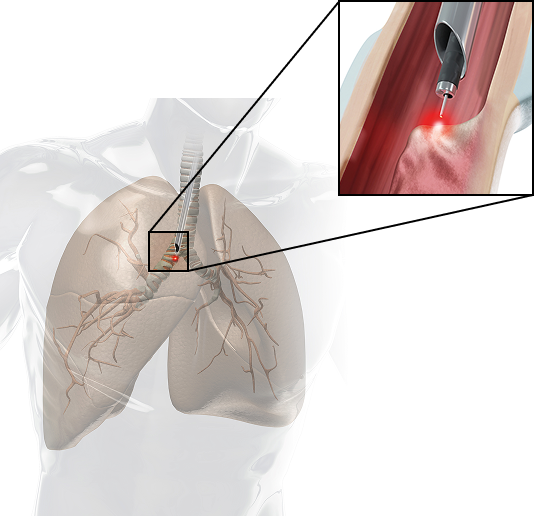
Ablation
of bronchial
tumor

In combination with robot-assisted systems, the LEONARDO® DUAL enables highly precise and controlled laser application in modern thoracic surgery.
Dr. Alexander Kern, thoracic surgeon
With the LEONARDO® DUAL, we have a modern laser system at our disposal that enables particularly precise and tissue-preserving treatment in thoracic surgery.
Dr. Davor Stamenovic, thoracic surgeon
The use of the LEONARDO® DUAL laser allows us to treat diseased lung tissue with very high precision while preserving healthy tissue to the greatest possible extent.
Prof. Dr. med. Bassam Redwan FRCP FACS
Videos of the procedure
Laser-based interventional pulmonology with dual-wavelength medical laser
Products
Our user-friendly medical diode lasers for thoracic laser surgery and interventional pulmonology provide a fast ROI thanks to low maintenance costs, affordability, and the much faster procedures resulting from the use of the technology.
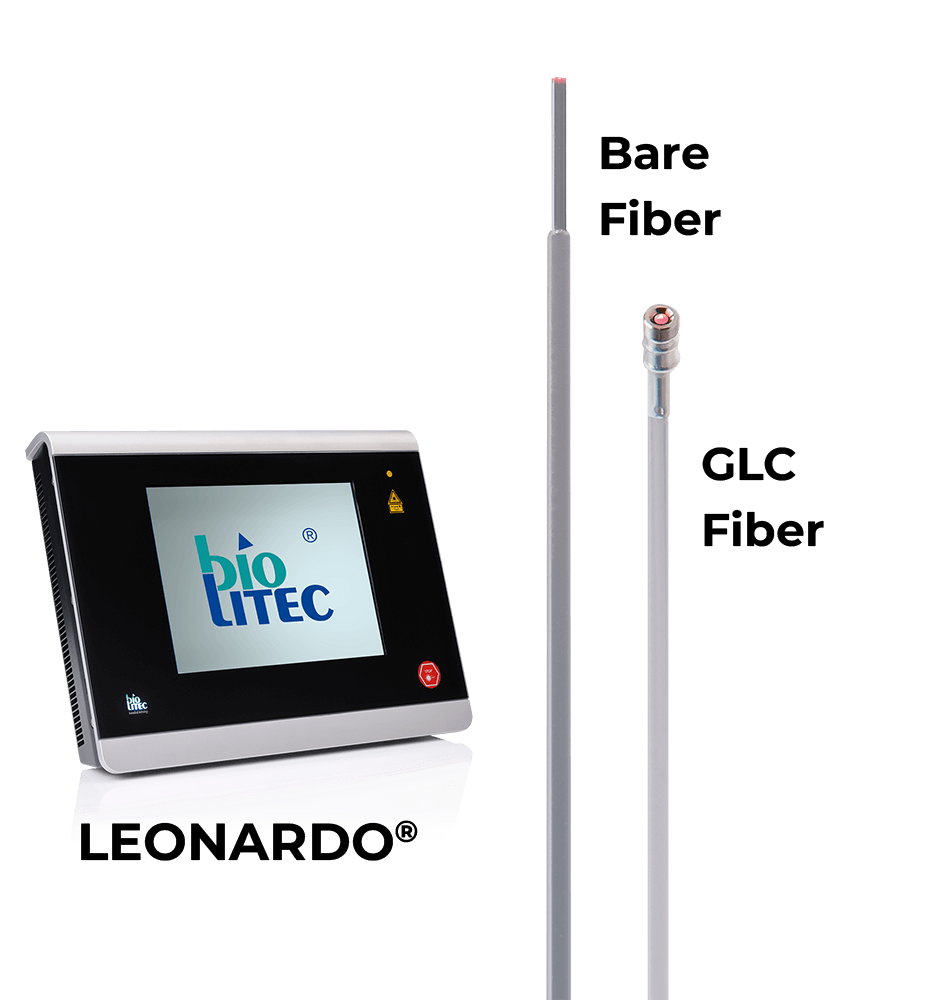
LEONARDO® DUAL 100
A compact and versatile laser, offering the power you need and operating with the ideal wavelength combination of 1470 nm and 980 nm.
GLC Fiber or Bare Fibers
For contact applications in thoracic surgery, our bare fibers are perfect for the job.
For non-contact applications such as the removal of bronchial tumors, we recommend GLC (gas- or liquid-cooled) fibers.
Handpieces are available for VATS/Uniportal VATS as well as robotic surgery.
Frequent Questions
What are the main applications of minimally invasive lasers in thoracic surgery?
- Metastasectomy
- Vaporization of tumors
- Wedge excision of lung tissue
- Resection of multiple and deep lung metastases
- Recurring metastases and tumors
- Hemostasis and fistula sealing
- Adhesiolysis
- Tissue resection for histological examination
What are the main applications of minimally invasive lasers in interventional pulmonology?
- Coagulation and ablation of endobronchial tumors and stenoses
- Removal of bronchial obstructions and fistulas
- Separation of tracheal stenoses
All procedures are performed with rigid or flexible endoscopes.
Can laser cutting and sealing be used in combination with video-assisted thoracoscopic surgery (VATS)?
Yes, our diode laser systems such as the DUAL 100 can be integrated into the VATS/Uniportal VATS procedure (video-assisted thoracoscopic surgery), offering all the same benefits, including simultaneous cutting and sealing.
Can minimally invasive thoracoscopic laser surgery and laser procedures for interventional pulmonology be combined with robotic surgery?
Yes, lasers like the biolitec DUAL 100 can be integrated into robotic surgery and are compatible with many systems, including semi-robotic instruments. Corresponding handpieces are available.
Is a pathology of metastases possible when using laser surgery?
Yes, metastases are excised over a large area, which means they can be preserved for later analysis.
Which parts do I need for a minimally invasive medical laser system that can be used for thoracic surgery or for interventional pulmonology?
Generally, the system consists of the laser itself (such as the biolitec laser DUAL 100), a corresponding fiber and a handpiece. Different handpieces are needed for open surgery, VATS or robotic surgery respectively. Additional accessories are available.
Can the laser procedure also be performed on an outpatient basis?
Thoracic laser surgery is performed on an inpatient basis. However, for interventional pulmonology (for example coagulation and ablation of bronchial tumors), outpatient procedures are possible.
As a surgeon, how can I learn thoracic laser surgery?
biolitec® regularly organizes workshops at international centers of expertise that teach both theoretical and practical fundamentals. They are designed to help physicians learn the procedure faster and apply it in a safe way. Contact us for dates and reserve your slot!
What is the difference between contact and non-contact fibers/laser applications?
Contact fibers (such as our bare fibers) are applied directly to the tissue and are used for cutting. They are ideally suited for thoracic surgery. Non-contact fibers (such as our GLC fibers) are held above the tissue, while the laser beam enters the tissue at a distance. The non-contact approach is used for ablation and coagulation such as in the field of interventional pulmonology.
The content on this website is intended exclusively for healthcare professionals and is not directed to the general public
Patients seeking information about treatments should consult a qualified healthcare provider. biolitec® does not provide medical advice through this site.